A mallard up-ending in a park lake looks slapstick: tail in the air, orange feet kicking. Under the surface the bill is doing skilled work. Almost every odd duck fact is a piece of kit, not a party trick.
The bill is a sieve
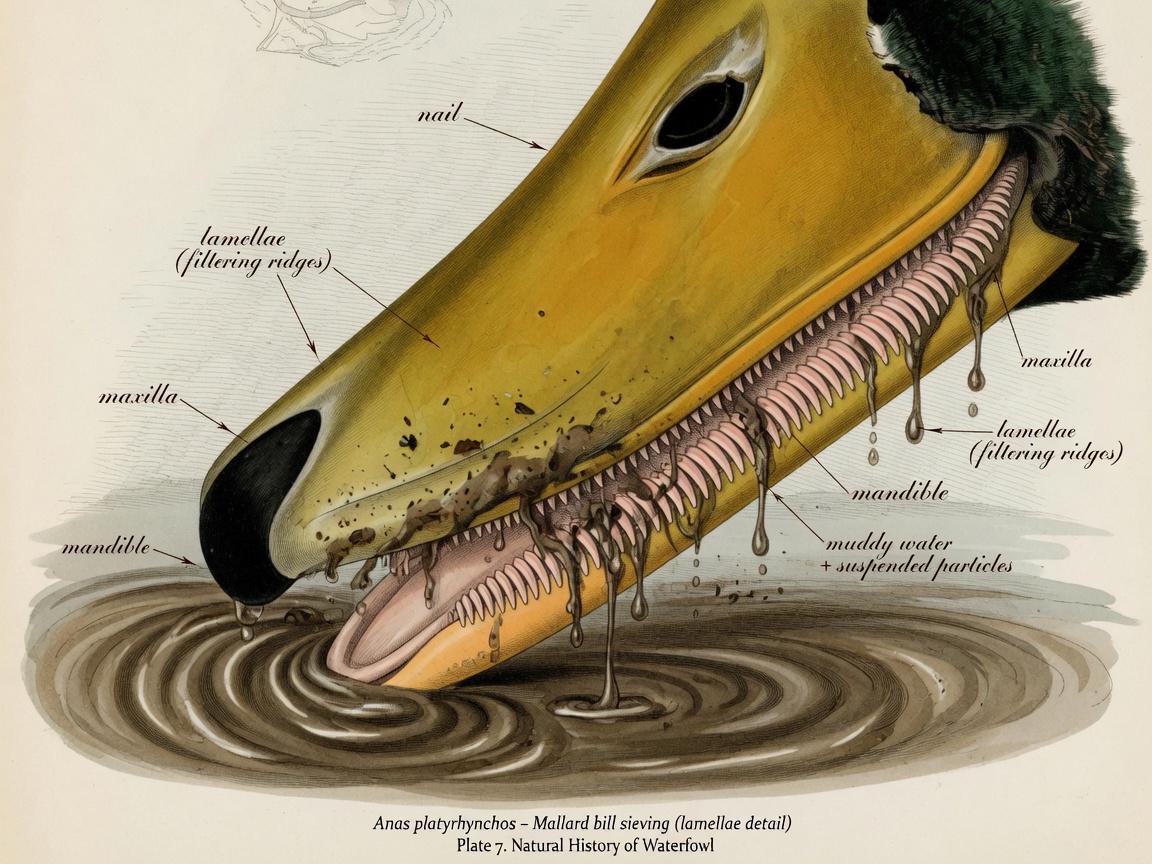
Dabbling ducks have lamellae — comb-like plates along the edges of the bill. They take a mouthful of muddy water and press it out through the combs, keeping seeds and invertebrates. A mallard may have well over a hundred plates.
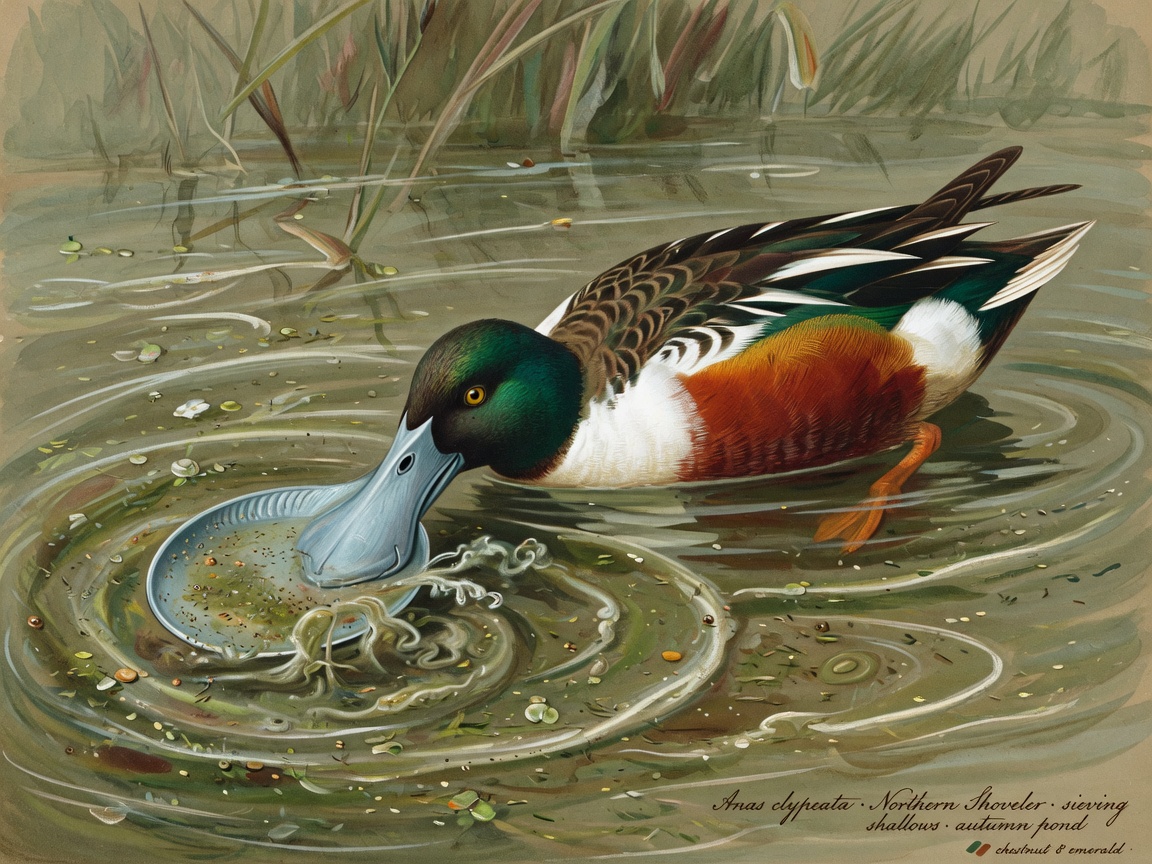
Shovelers take the idea further: their bill is a spoon with a denser comb, made for soup-thick shallows. Diving ducks such as pochard and tufted duck are built differently. They chase and grab rather than sieve. If you watch one vanish and come up with a mussel, you are looking at a different job.
| Kind | How they feed |
|---|---|
| Dabbler | Mallard, teal, shoveler — sieve at the surface |
| Diver | Tufted duck, pochard, eider — chase and grab |
Waterproofing is labour
Near the tail sits the uropygial gland, often called the preen gland. It secretes oil. The duck spreads that oil through the feathers with its bill, the way you would wax a jacket. Skip preening and the coat soaks; a wet duck loses heat fast.
“Water off a duck’s back” is real, and it is work. Ducklings get a head start from down and time with the female. They still have to learn the preen.
Eyes on the sides of the head
A duck’s field of view is enormous — useful when foxes exist. Many species also have a third eyelid, the nictitating membrane, which slides across like a swimming goggle. Colour vision is strong, and ultraviolet matters more to them than it does to us.
That is why a bird on a path can see you coming from almost behind. It is not magic. It is placement.
Cold feet, warm bird
Arteries and veins in the legs run as a counter-current heat exchanger. Warm blood heading down heats the cold blood heading back up. The feet sit near water temperature; the body core does not. A mallard can nap on ice without donating its heat to the lake.
They are not numb statues. There are still nerves and vessels in the feet. The trick is plumbing, not a missing nervous system.
Who actually quacks
The theatrical park quack is usually the female. Drakes have a drier, rattling courtship call. If you only know “quack”, you have been listening to one half of the species.
Sleeping with a watch set
Some ducks use unihemispheric slow-wave sleep: one brain hemisphere rests while the other keeps an eye open. Flocks on open water use it as a night watch. It is not insomnia.
Feathers in three jobs
Contour feathers shed water. Down holds air. Primaries are the flight tools. After breeding, many drakes moult those primaries at once and cannot fly for weeks — eclipse plumage, scruffy and quiet in the reeds. An August mallard that looks moth-eaten is not ill. It is grounded on purpose. Give it the cover.
Dabbler or diver, in one glance
The park joke — tail in the air — is a depth chart. Dabblers work the top few centimetres. Divers disappear. If you only remember one field rule, remember that.
Where the work happens
Schematic, not a scale drawing. Shoveler is the sieve taken further; eider is the grab taken to sea.
A shoveler in six inches of soup is fully employed. A tufted duck in the same soup looks bored, then vanishes. That is not mood. It is a different bill, a different foot, a different oxygen budget.
A few numbers that stick
| Mallard (typical) | Tufted duck | Northern shoveler | |
|---|---|---|---|
| Length | 50–65 cm | 40–47 cm | 44–52 cm |
| Weight | 0.7–1.6 kg | 0.5–1.0 kg | 0.4–1.1 kg |
| Clutch | 8–13 eggs | 8–11 | 8–12 |
| Incubation | ~28 days | ~25 days | ~22–25 days |
| Job | Sieve + graze | Dive for mussels | Dense comb in shallows |
These are field orders of magnitude, not a lab sheet. A farm mallard can be heavier; a hungry teal is a different animal entirely. Carry a field guide if you want names that survive a second look. An 8×42 pair of binoculars is enough for a gravel pit; a spotting scope earns its keep on a reservoir in January.
In the hide
Names first, then glass
The anatomy is easier when the bird has a name. We keep a short comparison of field guides and of 8×42 versus a scope. The glass search is 8×42 binoculars.
The radiator, drawn small
The counter-current in the legs is easier to believe as a picture than as a sentence. Warm blood goes down beside cold blood coming up. Heat hops across. The feet are allowed to be nearly as cold as the ice. The core is not.
Heat stays in the bird
Arteries and veins run side by side. The “no blood in the feet” myth is a radiator misunderstood.
A mallard year, in twelve blocks
What the month is actually for
Mallards mix residents and visitors. Teal and wigeon lean harder on the winter blocks. Garganey is the scarce green of May.
If you only visit in August you will think Britain has lost its drakes. They are in the reeds, flightless, wearing last year’s joke. Come back in January with a flask and a waterproof notebook. The list is longer, and quieter, and it is the real site.