On screen
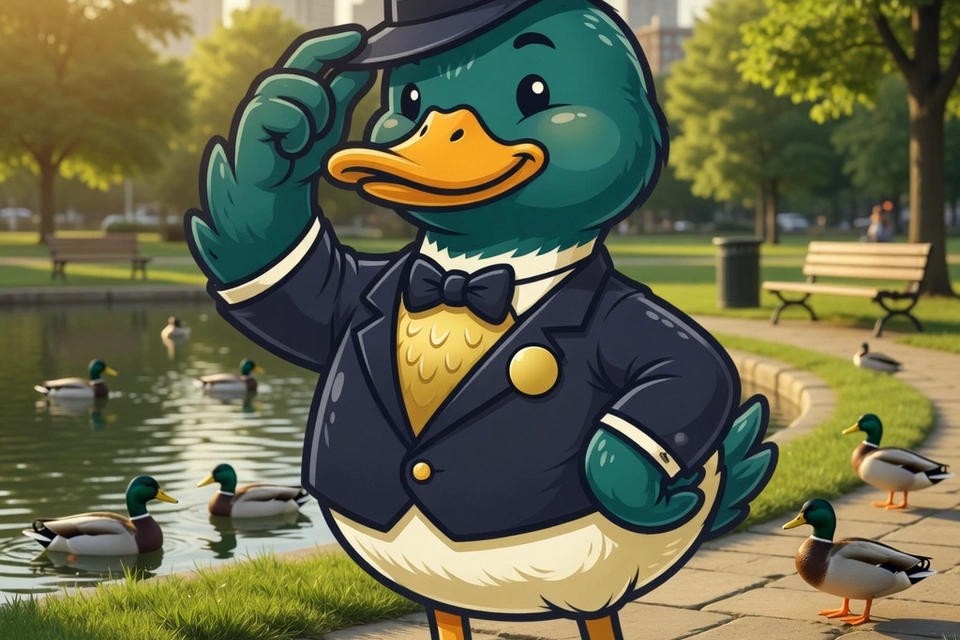
Donald Duck arrived in 1934 in The Wise Little Hen, already short-tempered, already in a sailor suit. Clarence “Ducky” Nash’s voice did most of the work. In parts of Europe he outsold Mickey for years. His middle name, Fauntleroy, is a real credit, not a fan invention.
Daffy Duck is the other pole: Tex Avery chaos that hardened into jealousy opposite Bugs Bunny. Between them they taught a century of children that a duck can be the straight man or the disaster.
Duck Hunt on the NES added a laughing dog. The Mighty Ducks (1992) added a hockey team, two sequels, and, eventually, an NHL franchise in Anaheim. Howard the Duck remains the cautionary tale: a 1986 film so odd it became a cult object.
None of that is natural history. It is why a mallard on a canal still gets a cheer.
In English
A handful of phrases are actually about the bird.
- Water off a duck’s back — preen oil doing its job.
- Sitting duck — a bird on the water is easier to shoot than one in the air. The metaphor is ugly because the practice was.
- Lame duck — 18th-century London Stock Exchange slang for a trader who could not pay, later a politician whose term is ending.
- Get your ducks in a row — origin disputed. Bowling pins and actual ducklings both get the credit. Nobody has a signed receipt.
Then there is duck as an endearment in the Midlands and the North. “Alright, duck?” has nothing to do with waterfowl and everything to do with warmth. Duck! as a warning is the verb, from a different root: to dip or dodge.
In books
Beatrix Potter’s Jemima Puddle-Duck is a farmyard farce with a fox in it. Hans Christian Andersen’s Ugly Duckling is not a duck at all — it is a swan, which is the point and also a small injustice to perfectly decent brown ducklings.
The book that still works as a street guide is Robert McCloskey’s Make Way for Ducklings (1941). Mrs Mallard walks her brood through Boston. The bronze birds in the Public Garden are still polished by children. If you only buy one duck book, that is the one. Elisha Cooper’s The Duck is a quieter modern companion: a year in a working bird, not a mascot.
In art and ritual
Mandarin ducks appear on Chinese wedding gifts as a pair that stays together. Wild pairs are close; “for life” is the postcard version. Japanese woodblock prints use ducks as autumn and still water.
Celtic and some Native American traditions treat waterbirds as creatures that move between air, land, and water — which is, zoologically, fair.
The British contribution is smaller and damper: the village pond. It is often the first wild animal a child is allowed to stand next to. That is why the bread argument is not trivial. A first lesson that says “kindness is a loaf” is a hard one to unteach. Peas, a pause, and a name for the bird are a better start.
The feeding and respect pages are the practical half of the same thought.