Most ducklings leave the nest within hours of hatching. They are nidifugous: born ready to walk and, soon after, to swim. They do not need us to teach them the water. They need us not to put a dog, a car, or a fishing hook in the way.
Imprinting

The first large moving object becomes “parent”. That is almost always the female. If people pick the brood up, the chicks may imprint on a human, a dog, or a boot, and fail to join wild birds later.
If they are stuck in a drain, a window well, or a fenced court, call a licensed rehabilitator. A cardboard box in a garage is not a rescue.
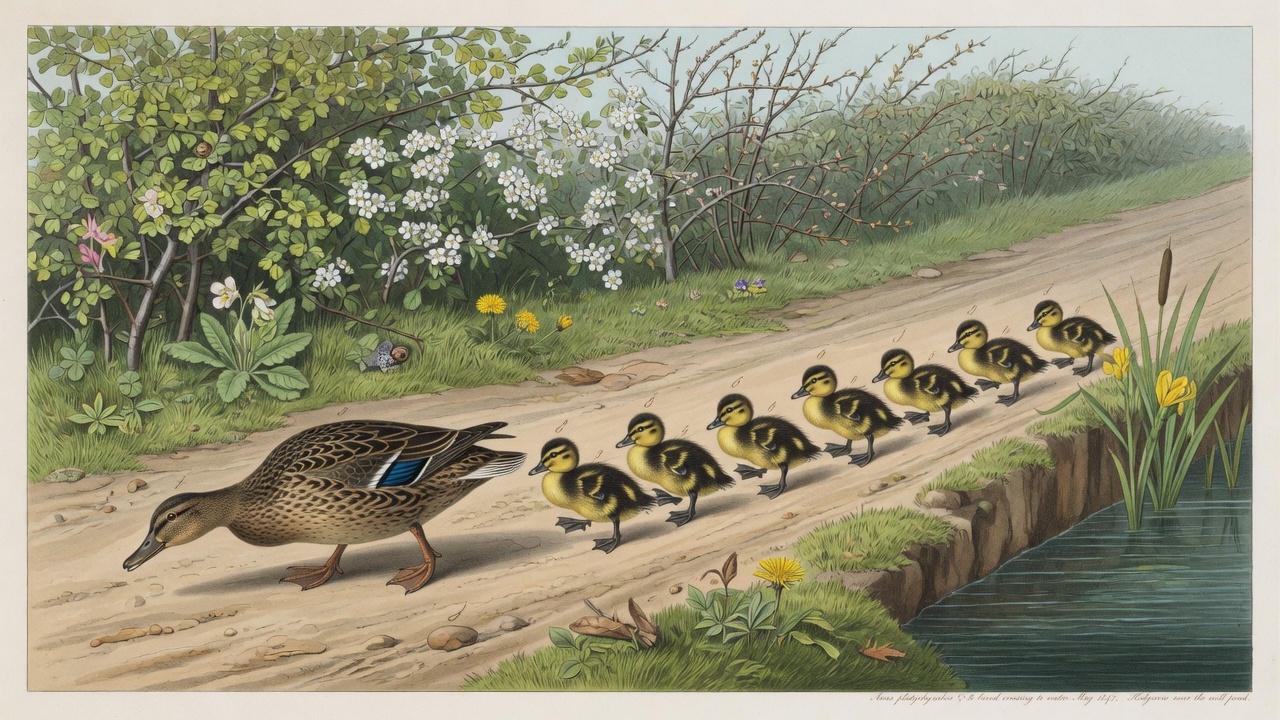
Nesting in Britain
Mallards nest from early spring into summer, on the ground: under brambles, in planters, against a fence a surprising walk from water. Keep dogs on a lead on waterside paths from April through July. A friendly retriever in the reeds is still a predator.
Food and cold
Ducklings sieve tiny invertebrates. They need protein for bone and feather. Bread is worse for them than for adults. They also chill quickly if they are flushed off the water again and again.
Some females end up with mixed-age groups when broods collide. Do not “even them out” by swapping chicks between families.
The first eight weeks
Mallard eggs take about four weeks. The chicks then do almost everything in public: walk, swim, sieve, nap in a pile that looks like a dropped glove. The dangerous part is not the water. It is the commute — roads, dogs, drains, and people who think a cardboard box is a kindness.
Rough mallard timetable
Urban survival is a coin toss. A lead on a spring path moves the coin.
Clutches of eight to thirteen look generous until you watch May. Magpies, pike, cars, cold rain, and the friendly off-lead retriever all take a cut. A female with four half-grown young in June is often a success, not a failure. Do not “top up” her brood with a chick from the next nest. Mixed ages happen on their own; forced mixing is how imprinting goes wrong.
What they actually eat
Ducklings are not bread-shaped. They need protein: midge larvae, tiny snails, the animals a muddy shelf still holds. A tidy concrete edge with no plants is a pretty desert. If you keep a garden pond, shelves and native plants do more than a bag of feed. A waterproof notebook is the right souvenir of a brood you did not touch.